


Page 95 - Xmo Strata - Bulletin Archive
P. 95
Page 6 of 6


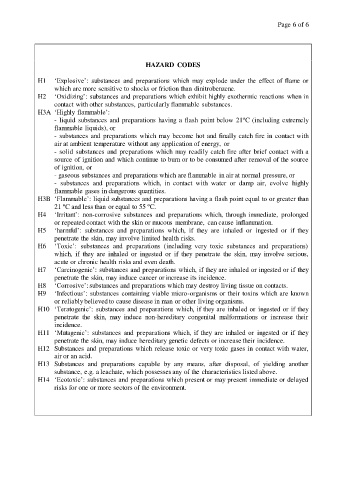
                                                    HAZARD  CODES

              H1  ‘Explosive’:  substances  and  preparations  which  may explode under the effect of flame or
                    which are more sensitive to shocks or friction than dinitrobenzene.
              H2  ‘Oxidizing’: substances and preparations which exhibit highly exothermic reactions when in
                    contact with other substances, particularly flammable substances.
              H3A  ‘Highly flammable’:
                    - liquid  substances and preparations having a flash point below 21ºC (including extremely
                    flammable liquids), or
                    - substances and preparations which may become hot and finally catch fire in contact with
                    air at ambient temperature without any application of energy, or
                    - solid substances and preparations which may readily catch fire after brief contact with a
                    source of ignition and which continue to burn or to be consumed after removal of the source
                    of ignition, or
                    - gaseous substances and preparations which are flammable in air at normal pressure, or
                    -  substances  and  preparations  which,  in  contact  with  water  or  damp  air,  evolve  highly
                    flammable gases in dangerous quantities.
              H3B  ‘Flammable’: liquid substances and preparations having a flash point equal to or greater than
                    21 ºC and less than or equal to 55 ºC.
              H4  ‘Irritant’:  non-corrosive  substances  and  preparations  which, through immediate,  prolonged
                    or repeated contact with the skin or mucous membrane,  can cause inflammation.
              H5  ‘harmful’:  substances  and  preparations  which,  if  they  are  inhaled  or  ingested  or  if  they
                    penetrate the skin, may involve limited health risks.
              H6  ‘Toxic’:  substances  and  preparations  (including  very  toxic  substances  and  preparations)
                    which,  if  they  are  inhaled  or  ingested  or  if  they  penetrate  the  skin,  may  involve serious,
                    acute or chronic health risks and even death.
              H7  ‘Carcinogenic’: substances and preparations which, if they are inhaled or ingested or if they
                    penetrate the skin, may induce cancer or increase its incidence.
              H8  ‘Corrosive’: substances and preparations which may destroy living tissue on contacts.
              H9  ‘Infectious’: substances containing viable micro-organisms or their toxins which are known
                    or reliably believed to cause disease in man or other living organisms.
              H10  ‘Teratogenic’: substances and preparations which, if they are inhaled or ingested or if they
                    penetrate  the  skin,  may  induce  non-hereditary  congenital  malformations  or  increase  their
                    incidence.
              H11  ‘Mutagenic’:  substances  and  preparations which, if they are inhaled or ingested or if they
                    penetrate the skin, may induce hereditary genetic defects or increase their incidence.
              H12  Substances and preparations which release toxic or very toxic gases in contact with water,
                    air or an acid.
              H13  Substances  and  preparations  capable  by  any  means,  after  disposal,  of  yielding  another
                    substance, e.g. a leachate, which possesses any of the characteristics listed above.
              H14  ‘Ecotoxic’: substances and preparations which present or may present immediate or delayed
                    risks for one or more sectors of the environment.

