


Page 873 - Xmo Strata - Bulletin Archive
P. 873
Some  of  these  rules,  particularly  this  type  of rule governing more generic issues that work specific,
           depend  on  much  more  than  just  following  the  protocol  of  a  typical  work  site.  They  demand  your
           subscription to a culture of good behavioural safety.

           To embrace these rules, they need to become second nature, a force of habit, like putting your seatbelt
           on when you get into the car or putting salt on your chips! It just has to be the way you do things, and
           that’s that!

           In  this  case,  the  operative  had  supervised  sites  himself  before  and  had  been  in  a  position  of
           responsibility where he enforced with others not to use their phones during such operations.  Here, he
           was distracted, busy, under pressure and that’s why he didn’t think to hang up the phone before moving
           the van. However, if he took a phone call having just paid for his bag of chips, would that distract him
           enough  that  he  would  forget  to  put  salt  on  his  chips?  Forgive  the  example,  but…  unlikely!  It  is
           imprinted  in  our  sub-conscience  and  we  do  it  automatically.  And  this  is  how  these  LIFE  SAVING
           Rules need to be, second nature.

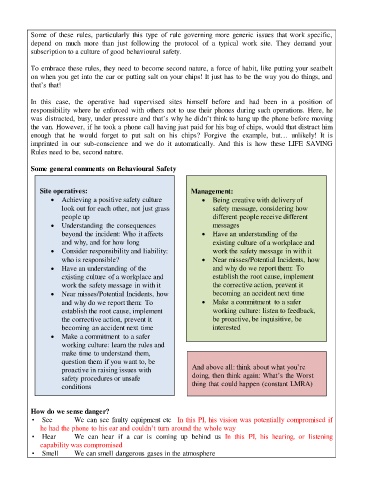
           Some general comments on Behavioural Safety


              Site operatives:                                  Management:
                  •  Achieving a positive safety culture            •  Being creative with delivery of
                     look out for each other, not just grass           safety message, considering how
                     people up                                         different people receive different
                  •  Understanding  the consequences                   messages
                     beyond the incident: Who it affects            •  Have an understanding  of the
                     and why, and for how long                         existing culture of a workplace and
                  •  Consider responsibility and liability:            work the safety message in with it
                     who is responsible?                            •  Near misses/Potential Incidents, how
                  •  Have an understanding  of the                     and why do we report them: To
                     existing culture of a workplace and               establish the root cause, implement
                     work the safety message in with it                the corrective action, prevent it
                  •  Near misses/Potential Incidents, how              becoming an accident next time
                     and why do we report them: To                  •  Make a commitment  to a safer
                     establish the root cause, implement               working culture: listen to feedback,
                     the corrective action, prevent it                 be proactive, be inquisitive, be
                     becoming an accident next time                    interested
                  •  Make a commitment  to a safer
                     working culture: learn the rules and
                     make time to understand them,
                     question them if you want to, be
                     proactive in raising issues with            And above all: think about what you’re
                     safety procedures or unsafe                 doing, then think again: What’s the Worst
                     conditions                                  thing that could happen (constant LMRA)


           How do we sense danger?
            •   See       We can see faulty equipment etc    In this PI, his vision was potentially compromised if
              he had the phone to his ear and couldn’t turn around the whole way
            •   Hear      We  can  hear  if  a  car  is  coming  up  behind  us  In  this  PI,  his  hearing,  or  listening
              capability was compromised
            •   Smell     We can smell dangerous gases in the atmosphere

