


Page 1028 - Xmo Strata - Bulletin Archive
P. 1028
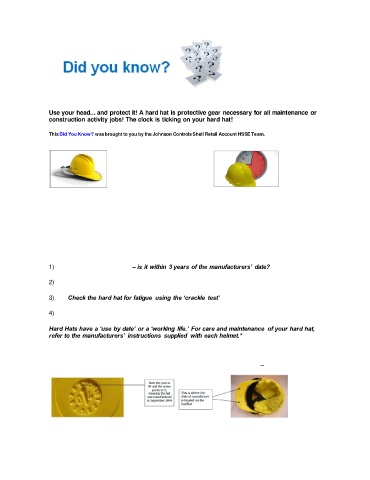
Use your head... and protect it! A hard hat is protective gear necessary for all maintenance or
                 construction activity jobs! The clock is ticking on your hard hat!

                 This Did You Know? was brought to you by the Johnson Controls Shell Retail Account HSSE Team.
                 If you have a topic to share please contact Coralie.Straughan@jci.com


                                                Inspect before every use.

                 Selecting  a Hard Hat:

                 If no hazard assessment  is conducted,  the worker should default  to the highest  protection
                 level which is the Type 2, class E protective  helmet. (E- is for electric)
                 In Canada,  POST (Petroleum Oriented Safety Training) recommends  the CSA approved  Type I
                 or Type 2 helmet (pg. 8 of the Guide).

                 HOW TO CHECK YOUR HARD HAT?
                 BASIC STEPS:
                 1)        Inspect your Hard Hat – is it within 3 years of the manufacturers’ date?

                 2)        Check for visible  dents, cuts, nicks,  gouges  or other damage  to the shell

                 3)        Check the hard hat for fatigue  using the ‘crackle  test’


                 4)        Check the webbing and harness for good repair

                 Hard Hats have a ‘use by date’ or a ‘working  life.’ For care and maintenance  of your hard hat,
                 refer to the manufacturers’ instructions  supplied  with each helmet.*

                 Each hard hat has a year and month of manufacture  stamped  onto the inside  of the shell near
                 the peak for easy reading. The arrow in the stamp  points  to the month and the year overlays
                 the arrow. For example  below, the arrow points  to 9 and the number is 04 – meaning  that the
                 helmet was manufactured  in September 2004.


                 An expiry date is in place  as a safeguard  for you as a worker. If the helmet  has been used
                 regularly it should be replaced  after 3 years from the date of issue. In essence, if a helmet has
                 been issued before August 2010, it is out of date and should be replaced.  When in doubt,
                 replace the protective  headgear

